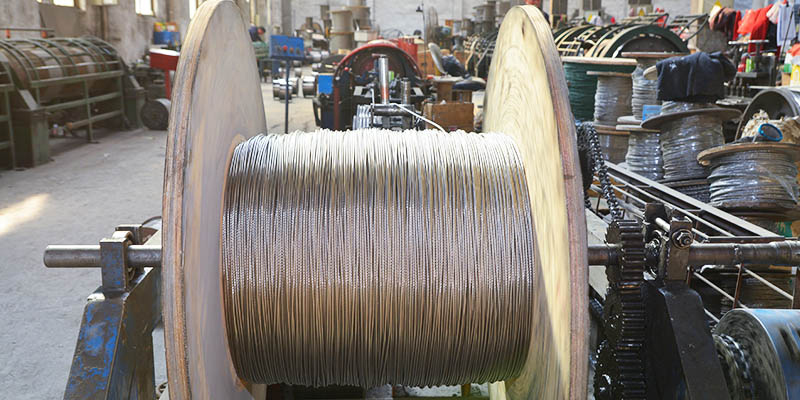
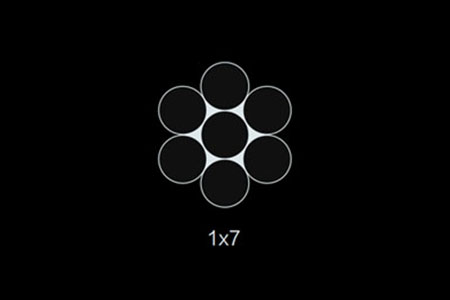
1×7 Stainless Steel Wire Rope Product Introduction Overview: The 1×7 stainless steel wire rope is a high-quality, durable, and versatile wire rope constructed from a single strand of seven individual ...
See Details

A 10 mm 7x19 stainless steel wire rope carries a minimum breaking load near 71.5 kN, enough to suspend seven metric tons in a single lift. That specification explains why stainless steel wire, drawn into filaments as fine as 0.2 mm and stranded into ropes over 60 mm in diameter, is the default tension, suspension, and fastening material across modern industry. No competing alloy family matches its chloride resistance, predictable elongation, and tensile range of roughly 490 MPa to more than 2,000 MPa. From ship mooring lines to bridge cable barriers, stainless steel wire carries the loads that keep industrial systems standing.
Strand geometry determines how a stainless steel wire rope behaves long before grade selection does. A 1x19 rope will not bend like a 7x19 rope, and a 6x36 rope with an independent wire rope core will not flex like a 7x7. Choosing the wrong construction is the most common specification error in industrial procurement, showing up as premature fatigue fractures or unexpected elongation under cyclic load.
Each construction balances flexibility, fatigue resistance, and metallic cross-section. More strands around a core create additional contact points, spreading bending stress but reducing the solid steel area available to carry tension. A 1x19 rope maximizes strength for its diameter but fails quickly under repeated bending; a 7x19 rope survives millions of bending cycles on crane and winch drums.
| Construction | Flexibility | Fatigue life | Typical use |
| 1x7 / 1x19 | Low | High under static load | Standing rigging, structural ties |
| 7x7 | Medium | Medium-high | Lanyards, push-pull cables, light suspension |
| 7x19 | High | High | Cranes, winches, lift and control cables |
| 6x36 WS FC | Medium-high | High | Heavy lifting, mining, large hoists |
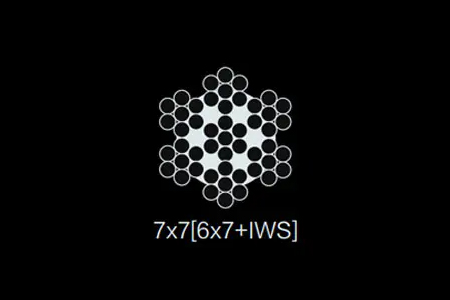 7x7 Stainless Steel Wire Rope in 304 or 316This 7x7 construction balances flexibility and strength for light to medium-duty rigging. Its grade options matter for corrosion resistance, so choose 316 for coastal or chemical environments.View Product →
Grade selection is a corrosion-engineering decision, not a cost decision. Type 304 stainless steel wire resists oxidation and general rusting in dry interiors and mildly humid atmospheres. Type 316 adds 2 to 3 percent molybdenum, sharply raising chloride pitting resistance, the failure mode that destroys ordinary stainless wire in coastal air, deicing salt, and chemical washdowns.
Engineers quantify this behaviour with the pitting resistance equivalent number, or PREN. Higher PREN predicts longer time to pitting in chloride-rich media. Type 304 sits near 19, type 316 near 26, 316L around 28, and duplex grades above 35. For marine rigging and offshore lifting, 316 is the baseline specification.
Pitting resistance equivalent numbers by grade
Higher PREN equals better chloride pitting resistance.
For a detailed breakdown of the metallurgical differences, read our engineering note on 304 vs 316 stainless steel grade selection.
Best for dry interior equipment, architectural trim, and applications without regular chloride exposure. Lower cost, good formability, adequate strength for static systems.
Required for coastal structures, chemical plants, food processing washdown areas, and marine-adjacent rigging. Higher pitting resistance, slightly higher cost per metre.
Three industrial sectors consume most of the stainless steel wire rope produced worldwide: marine and offshore, construction and civil engineering, and architectural tensile systems. Each specifies stainless steel for a different reason, yet all rely on the same strength-plus-corrosion-resistance combination.
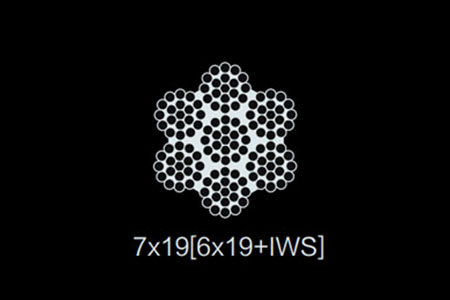 7x19 with IWS Stainless Steel Wire Rope in 304 or 316This rope's 6x19+IWS design offers enhanced flexibility and abrasion resistance, making it suitable for dynamic lifting and rigging where repeated bending and heavy loads are expected.View Product →
Stainless steel wire is not only a finished tension member; it is also the starting material for fasteners, welding consumables, springs, and formed metal parts. Cold-heading wire becomes bolts, screws, and nuts; TIG wire becomes the filler metal that joins stainless assemblies; drawn wire becomes pins, rings, and custom profiles.
A factory that integrates wire drawing, stranding, and surface treatment can supply several product families from the same metallurgical base. The same 316L chemistry used in marine-grade rope can become precision TIG wire for repairing terminations, or cold-heading wire for a DIN 933 hexagon bolt. JiangSu Kailong Stainless Steel Products Co., Ltd. positions itself as a high-requirement wire specialist because of this vertical integration.
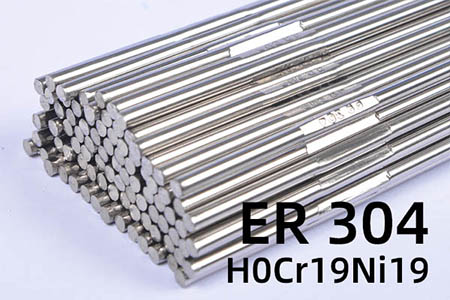 Precision Stainless Steel 304 TIG Welding WireThis ER 304 TIG wire is produced directly by the manufacturer, offering good corrosion and heat resistance. It suits food machinery, chemical equipment, and medical devices requiring clean welds.View Product →
Industrial buyers sourcing stainless steel wire should verify four things before placing a production order: material traceability, mechanical test data, surface condition, and process control.
A manufacturer that controls the full process can adjust construction, grade, packaging, and testing to match a specific application; a trader reselling imported coils cannot. That difference appears in delivery time, defect rates, and the ability to respond when a specification changes mid-order. To discuss required grades and constructions, contact the factory directly.
Specify 316 or 316L. The molybdenum content provides the chloride pitting resistance that coastal and offshore environments demand. Type 304 will corrode prematurely when exposed to salt spray or deicing chemicals.
7x7 wire rope has seven strands over a single core strand, giving medium flexibility and good strength for lanyards and light suspension. 7x19 has nineteen outer strands, delivering higher flexibility and longer bending fatigue life for winches, cranes, and control cables.
Yes, with matching filler metals. Austenitic grades such as 304 and 316 are welded with 308L and 316L TIG wire respectively. The filler must be free from surface contamination, which is why precision-drawn stainless TIG wire is specified for critical welds.
In coastal atmospheric exposure, 316 stainless wire rope commonly exceeds 25 years of service, while 304 may show pitting within 3 to 7 years depending on chloride concentration and surface condition. Regular freshwater rinsing extends both service lives.
1×7 Stainless Steel Wire Rope Product Introduction Overview: The 1×7 stainless steel wire rope is a high-quality, durable, and versatile wire rope constructed from a single strand of seven individual ...
See Details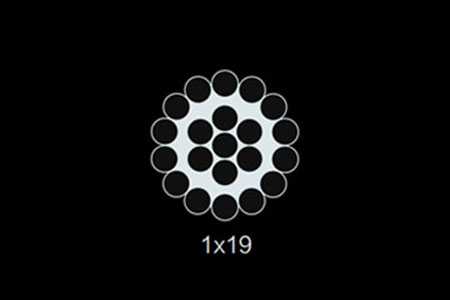
1×19 Stainless Steel Wire Rope Product Introduction Overview: The 1×19 stainless steel wire rope is a robust and high-strength wire rope made from a single strand of 19 individual wires twisted togeth...
See Details
7×7 Stainless Steel Wire Rope Product Introduction Overview: The 7×7 stainless steel wire rope is a versatile, durable, and flexible wire rope made from seven strands, each containing seven individual...
See Details![7X19 [6x19+IWS] Stainless Steel Wire Rope 304/316](/steelwirerope-china/2024/12/20/4.jpg)
7X19 [6x19+IWS] Stainless Steel Wire Rope Product Introduction Overview: The 7X19 [6x19+IWS] stainless steel wire rope is a high-performance wire rope designed for applications that require maximum st...
See Details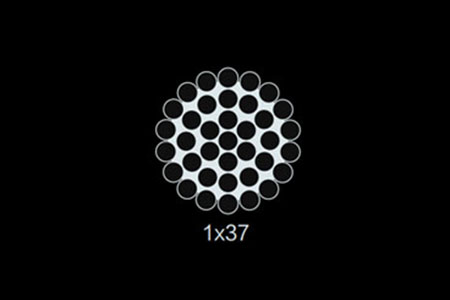
1×37 Stainless Steel Wire Rope Product Introduction Overview: The 1×37 stainless steel wire rope is a high-strength, durable wire rope made from a single strand of 37 individual wires twisted together...
See Details
6×7+FC Stainless Steel Wire Rope Product Introduction Overview: The 6×7+FC stainless steel wire rope is a high-quality wire rope designed for applications requiring both strength and flexibility. This...
See Details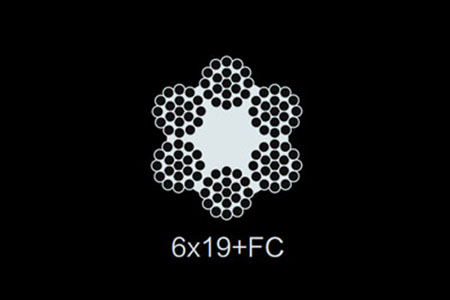
6×19+FC Stainless Steel Wire Rope Product Introduction Overview: The 6×19+FC stainless steel wire rope is a high-performance, versatile rope designed to provide exceptional strength, flexibility, and ...
See Details
19×7 Stainless Steel Wire Rope Product Introduction Overview: The 19×7 stainless steel wire rope is a high-performance wire rope designed for a wide range of applications requiring both strength and f...
See Details




 wechat scan