1×7 Stainless Steel Wire Rope Product Introduction Overview: The 1×7 stainless steel wire rope is a high-quality, durable, and versatile wire rope constructed from a single strand of seven individual ...
See Details


Wire rope construction — the specific arrangement of individual wires into strands, and strands around a core — is the fundamental specification that determines a wire rope's mechanical properties: its flexibility, its breaking strength, its resistance to fatigue, its resistance to abrasion, and its suitability for different working environments and rigging configurations. Two wire ropes of the same diameter and the same material can have dramatically different service lives and performance characteristics in the same application if their constructions are different. For engineers specifying wire rope for a load-bearing application, riggers selecting rope for a specific rigging configuration, and procurement teams sourcing stainless steel wire rope for marine, architectural, or industrial use, understanding the construction designation system and what each configuration means in practice is the starting point of a sound specification.
This guide explains the wire rope construction designation system, covers the main standard constructions used in stainless steel wire rope, and provides a practical framework for matching construction to application requirements.
A wire rope construction is described by a two-number designation in the format Strands × Wires per Strand — for example, 7×7 means 7 strands, each containing 7 individual wires; 7×19 means 7 strands, each containing 19 individual wires. This designation tells you two critical things about the rope simultaneously: the total wire count (which determines wire diameter for a given rope diameter, which determines flexibility and abrasion resistance), and the strand count (which determines the rope's torque balance and suitability for different terminal fittings).
Additionally, the rope has a core — the central element around which the strands are laid. For stainless steel wire rope, the core is almost always either a wire strand core (WSC, a single central wire strand) or an independent wire rope core (IWRC, a small complete wire rope at the center). The WSC construction is more compact and slightly higher in breaking strength for a given diameter; the IWRC provides higher resistance to crushing and is preferred for applications involving pulleys and sheaves or where high lateral loads are anticipated.
A complete wire rope specification also notes the lay — the direction and pattern in which the strands are wound around the core. Regular lay (the most common) has the wires wound in the opposite direction to the strands; Lang's lay has both wires and strands wound in the same direction, giving better wear resistance and flexibility but requiring both rope ends to be restrained against rotation.
1×19 is not technically a stranded rope — it is a single strand of 19 individual wires laid together. Because it has no multi-strand structure, it is very rigid (the stiffest of the standard wire rope constructions) but has high breaking strength for its diameter due to the high fill factor of tightly packed wires.
Properties: Maximum rigidity and minimum flexibility of any standard construction. Very high breaking strength per unit diameter. Smooth surface (uniform wire diameter). Minimal stretch under load — the 1×19 construction has very low constructional stretch because the single-strand construction has no strand-to-strand settling.
Applications: Standing rigging on sailboats (shrouds, forestays, backstays) — where the rope must resist stretch to maintain mast position under sail load and where repeated flexing is minimal; architectural cable railing and cable trellis systems where long straight runs with minimal deflection are required; fixed tensioning applications where the rope does not bend over a sheave or pulley.
Not suitable for: Any application involving sheaves, pulleys, or repeated bending — the rigid 1×19 construction has very poor fatigue life under repeated bending cycles and will fail rapidly at bend points. Not suitable for running rigging or any application where the rope must flex in service.
7×7 is the standard intermediate construction — more flexible than 1×19 but less flexible than 7×19. It's 7 strands of 7 wires each give a total of 49 individual wires in the rope cross-section. For a given rope diameter, the individual wires are larger than in 7×19 (fewer, larger wires vs. more, smaller wires), which makes 7×7 more resistant to abrasion but less flexible than 7×19.
Properties: Moderate flexibility — can be bent around curves and terminated with swage fittings, but has limited tolerance for tight-radius bending or sheave use. Good breaking strength. Good abrasion resistance due to larger individual wire diameter. Moderate stretch under initial load (some constructional stretch as strands settle).
Applications: Control cables where light bending is required but maximum flexibility is not needed (aircraft control cables, bicycle brake and gear cables, automotive control cables); architectural balustrade and guardrail cable infill systems where the rope makes gentle curves around corner posts; marine standing rigging applications where 1×19 is too rigid for the fitting geometry; safety tether lines and fall protection systems; kits and assemblies where the rope terminates with swaged end fittings (the 7-strand construction is compatible with most swaging tools and fitting specifications).
Not suitable for: Running rigging on winches and sheaves with small bend radii (the 7-wire strand diameter is too large for good fatigue life in tight-radius bending cycles); applications requiring the extreme flexibility of 7×19.
7×19 is the standard flexible wire rope construction. Its 7 strands of 19 wires each produce 133 individual wires in the cross-section — for a given rope diameter, the individual wires are much finer than in 7×7 or 1×19, which is the source of 7×19's superior flexibility. More wires = finer wires = more flexibility.
Properties: High flexibility — the finest wire diameter of the three standard constructions for a given rope diameter makes 7×19 the most flexible option and the most suitable for bending over sheaves and around tight curves. Good breaking strength (slightly lower than 1×19 for the same diameter due to lower fill factor). Lower abrasion resistance than 7×7 because the individual wires are finer and more susceptible to surface wear. More constructional stretch than 1×19.
Applications: Running rigging on sailboats (halyards, sheets, control lines operating through blocks/sheaves); winch cables and crane falls; lifting and hoisting applications where the rope operates over sheaves; marine deck hardware and running gear; stainless steel wire rope for zoo enclosures and animal barriers where the rope must flex around curved enclosure profiles; security and safety netting with significant curvature; any application requiring maximum flexibility in the rope itself.
Not suitable for: Applications requiring high abrasion resistance against rough surfaces (the finer wires of 7×19 wear more quickly than the coarser wires of 7×7 in abrasive contact); ultra-low stretch applications such as sailboat standing rigging, where 1×19 or rod rigging is preferred.
6×19 is the standard construction for industrial wire rope in heavy lifting, crane, and hoist applications. Unlike the 7-strand constructions above, 6×19 uses 6 strands around a central core (wire strand core or independent wire rope core), with each strand containing 19 or more wires (the "6×19 class" in EN 12385 and related standards includes several specific constructions with wires per strand in the 16–26 range). The 6-strand construction with IWRC is standard for crane and hoist rope because it resists crushing in multi-layer drum spooling better than 7-strand constructions.
Applications: Tower cranes and mobile crane hoisting lines; overhead hoists and industrial lifting; mining and earthmoving machine ropes; elevator/lift ropes; any application involving large drum spooling under load. While stainless steel 6×19 rope is available, most 6×19 industrial rope is produced in galvanized or ungalvanized carbon steel, with stainless steel versions used for marine, offshore, and corrosive-environment crane and hoist applications.
| Construction | Total Wires | Flexibility | Breaking Strength* | Abrasion Resistance | Fatigue Resistance | Stretch | Primary Applications |
|---|---|---|---|---|---|---|---|
| 1×19 | 19 | Low (rigid) | Highest | High | Poor (avoid bending) | Minimal | Sailboat standing rigging, architectural cable, fixed tensioning |
| 7×7 | 49 | Medium | High | Good | Good for light bending | Low-medium | Control cables, balustrade infill, marine rigging, safety lines |
| 7×19 | 133 | High | Medium-high | Moderate | Excellent for sheave use | Medium | Running rigging, hoisting, winch cables, zoo mesh, safety netting |
| 6×19 (IWRC) | ~114+core | High | High | Good | Very good on sheaves | Medium | Industrial crane/hoist, mining, elevator, offshore lifting |
*Breaking strength comparison is for the same nominal diameter and the same material grade. Values are relative within each construction, not absolute.
The minimum breaking force (MBF) of a wire rope is calculated from the aggregate cross-sectional area of all the individual wires multiplied by the wire's tensile strength, adjusted for the rope's fill factor (how efficiently the wires pack into the nominal rope diameter). For a given nominal diameter, 1×19 has the highest fill factor (tightest packing) and therefore the highest MBF; 7×19 has a lower fill factor due to the spaces between strands and within strands, and therefore a lower MBF for the same nominal diameter than 1×19.
The safe working load (SWL) or working load limit (WLL) is derived from the MBF by applying a design factor (also called safety factor) — typically 5:1 to 8:1 for general lifting and rigging applications (higher factors for critical lifting where failure consequences are severe; lower factors for some architectural and non-lifting applications). The design factor is specified in the relevant standard for the application — EN 13411, ISO 4309, and other standards specify appropriate factors for different application types.
When selecting wire rope for a specific application, the required WLL determines the minimum MBF needed, which in turn determines the minimum rope diameter required for the chosen construction. The relationship is:
Required MBF = Required WLL × Design Factor
Required rope diameter = found from the manufacturer's MBF table for the chosen construction at the required MBF
For stainless steel wire rope, the two main material grades are 304 (1.4301) and 316 (1.4401 / 1.4436). Both are austenitic stainless steels with excellent general corrosion resistance, but they differ in their resistance to chloride-induced pitting and crevice corrosion:
Grade 304 is suitable for most indoor applications, fresh water contact, and mildly corrosive environments. It is the standard grade for architectural applications in inland environments, general industrial use, and freshwater marine applications.
Grade 316 contains 2–3% molybdenum added to the 304 composition, which substantially increases its resistance to chloride pitting — the mechanism by which seawater and coastal salt air corrodes stainless steel. Grade 316 is the standard specification for all marine applications (saltwater contact, coastal installations, offshore), swimming pool environments (chlorinated water), food processing, and any application where chloride exposure is anticipated. The cost premium over 304 is modest and is universally justified for marine and coastal applications.
Physically, a 7×19 rope in the same nominal diameter has a lower breaking force than a 1×19 (lower fill factor, as explained above) and significantly more stretch under tension. If a 1×19 rope was specified for a standing rigging or structural tensioning application, substituting 7×19 of the same diameter gives reduced breaking strength and more elongation under load — both of which may not meet the design requirements. To substitute 7×19 for 1×19, the 7×19 diameter must be increased to achieve the same MBF as the original 1×19 specification, and the elongation under working load should be recalculated to confirm it is acceptable for the application. In most standing rigging and architectural tension rod applications, 1×19 or 7×7 is the correct specification, not 7×19.
Wire rope nominal diameter is the diameter of the circumscribed circle that encloses the rope cross-section — it is measured across the outer surface of the outermost strands. For a 7-strand rope, this measurement is taken across two opposed outer strands. The measurement should be taken with a caliper at multiple points along the rope and at multiple angular orientations, then averaged — wire rope is not a perfect circle in cross-section, and a single measurement may understate the true diameter. Measuring into the valleys between strands gives an underreading; always measure across the highest points (outer wire crowns). The measured diameter should match the nominal diameter within the tolerance specified in the applicable standard (typically ±2–4% of nominal, depending on diameter and standard).
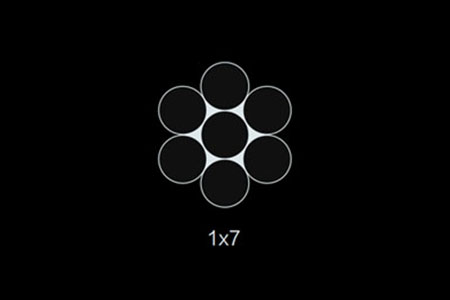
A wire strand is a single assembly of individual wires laid helically together — the component that is assembled in multiples to make a wire rope. A 7×19 wire rope, for example, consists of 7 wire strands, each strand being 19 individual wires twisted together. A 1×19 "rope" is technically a single strand — 19 wires twisted together with no further multi-strand assembly — which is why it is rigid and unsuitable for sheave use. Wire strand (1×19, 1×7) is used directly as a structural cable in architectural and rigging applications where rigidity and low stretch are required; wire rope (7×7, 7×19, 6×19) is used where flexibility, multi-layer spooling, or sheave operation is required.
Jiangsu Kailong Stainless Steel Products Co., Ltd., Xinghua, Jiangsu, manufactures stainless steel wire rope in 1×19, 7×7, 7×19, and 6×19 constructions in grades 304 and 316, from 1mm to 32mm nominal diameter. Full range of swaged and mechanical end terminals, wire rope rigging hardware, thimbles, swageless fittings, and turnbuckles available to complete wire rope assemblies. Products certified to EN 12385, AISI, and other applicable standards. Suitable for marine, architectural, industrial, and safety applications. OEM and custom lengths available for global distribution.
Contact us with your required construction, diameter, grade, length, and end fitting requirements to receive a quotation.
Related Products: Stainless Steel Wire Rope | Steel Wire Rope Rigging Hardware | Stainless Steel Wire Rope Mesh | Stainless Steel Wire | Stainless Steel Rod
1×7 Stainless Steel Wire Rope Product Introduction Overview: The 1×7 stainless steel wire rope is a high-quality, durable, and versatile wire rope constructed from a single strand of seven individual ...
See Details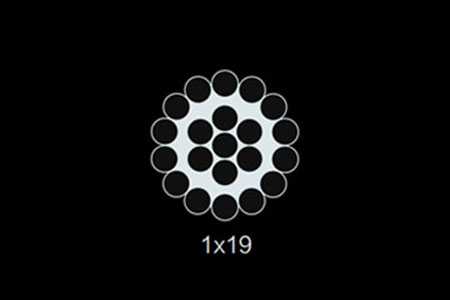
1×19 Stainless Steel Wire Rope Product Introduction Overview: The 1×19 stainless steel wire rope is a robust and high-strength wire rope made from a single strand of 19 individual wires twisted togeth...
See Details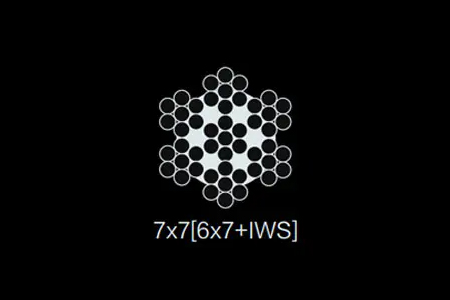
7×7 Stainless Steel Wire Rope Product Introduction Overview: The 7×7 stainless steel wire rope is a versatile, durable, and flexible wire rope made from seven strands, each containing seven individual...
See Details![7X19 [6x19+IWS] Stainless Steel Wire Rope 304/316](/steelwirerope-china/2024/12/20/4.jpg)
7X19 [6x19+IWS] Stainless Steel Wire Rope Product Introduction Overview: The 7X19 [6x19+IWS] stainless steel wire rope is a high-performance wire rope designed for applications that require maximum st...
See Details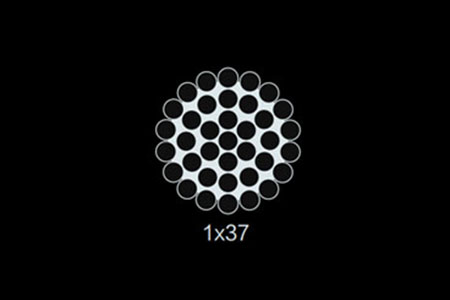
1×37 Stainless Steel Wire Rope Product Introduction Overview: The 1×37 stainless steel wire rope is a high-strength, durable wire rope made from a single strand of 37 individual wires twisted together...
See Details
6×7+FC Stainless Steel Wire Rope Product Introduction Overview: The 6×7+FC stainless steel wire rope is a high-quality wire rope designed for applications requiring both strength and flexibility. This...
See Details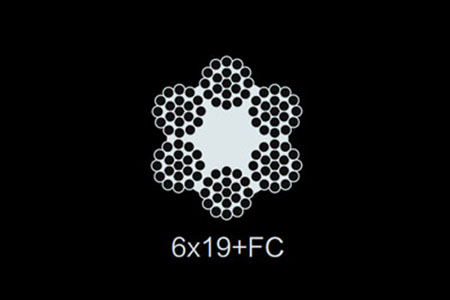
6×19+FC Stainless Steel Wire Rope Product Introduction Overview: The 6×19+FC stainless steel wire rope is a high-performance, versatile rope designed to provide exceptional strength, flexibility, and ...
See Details
19×7 Stainless Steel Wire Rope Product Introduction Overview: The 19×7 stainless steel wire rope is a high-performance wire rope designed for a wide range of applications requiring both strength and f...
See Details




 wechat scan